Posts

Revision, Retrieval and Games
Image
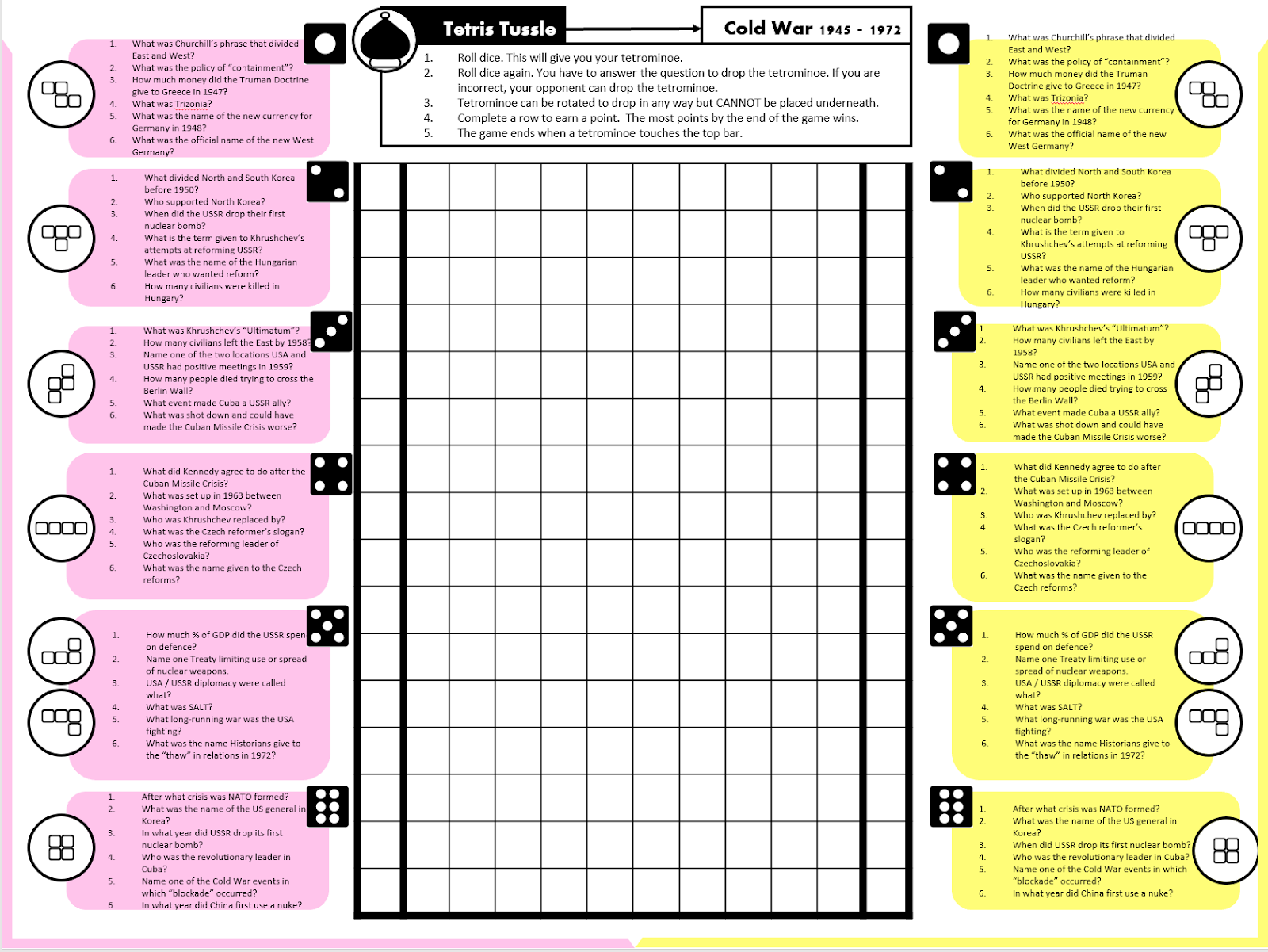
There is a longer post to be written about some of my recent experiments with exploring LGBTQ and race in History more fully in the curriculum. In the mean time I have been doing lots of revision with Year 10 in preparation for their end of Year exam. A little while ago I came across a great Tetris-derived revision game designed by @SPBeale . I used it to create a Cold War-themed version. You should find that each "Tetrominoe" includes questions from a different section of the course, except for two of them which cover the 1960s, and the final one which is a random selection of questions I couldn't fit in anywhere else. All questions can be changed depending on what you teach and which evidence you focus on. Instructions are all on the sheet - about half of my classes had never actually played Tetris before, so had to be guided at first. This may or may not be the case with yours.  All I can say is that the classes really seemed to enjoy the revision game; there was a def...
Integrating LGBTQ+ into the classroom

Image
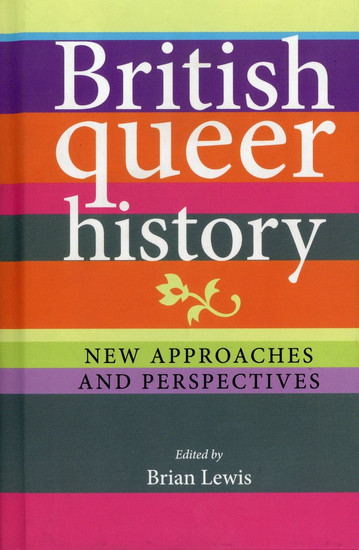
 I have been thinking about this for a while - inspired by Christine Counsel's ideas of curriculum development I explore elsewhere, as well as by a recent webinar I attended on "How to do LGBTQ History" which I thought was fascinating. I am currently reading this excellent book which addresses some of the current thinking in the historiography and in particular the key problem of terminology. In an era where the boundaries are being explored and where identity (both outward and inward) is important, the use of terms like "gay", "bisexual" and even "queer" become problematic. Individuals in the past may not recognise the terms historians and others use when discussing LGBTQ issues in the past. I first came across "queer" as a child in the 1980s when it was being used as a term of abuse, but it has reclaimed as a broad label for identities, or as this article by the National Archives  says it is " a label that encompasses the flu...

WW1 recruitment posters analysis, utility and curriculum development

Image
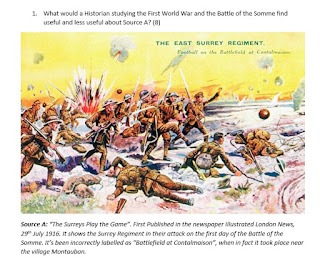
I am currently marking 3 sets' worth of tests for Year 9, which my school did this week for all subjects and all year groups 7-12. While I have a big concern about the efficacy of this as a process (Year 7 English is just not the same as Year 12 A Level Chemistry and should not be treated in the same way, for example) it got me thinking further about the way I have been approaching source analysis across the curriculum and the year groups I teach. I set this as a source analysis question at the end of a unit on the Western Front, with a focus on Verdun, the Somme and tank development. We had spent time analysing sources in different ways (what they can tell us about the past, the views they have, comparison, usefulness, reliability etc) Although I appreciate the wording could be different,  I chose this source because I felt there was a lot of potential in it and details which students could unpack. There were some good answers from good students, but only a few managed to get the ...

Teaching in Teams & Class Notebook

Image
My school rolled out Microsoft Teams to us in Summer 2018, and gave teachers the choice how far to use the new technology. All students were to be given a "Surface" laptop, but otherwise teachers were left to decide how far to adopt the new technology for the first year. Previously we had a "bring your own device" policy which  meant that some students worked on a laptop, but most had files with paper and KS3 had exercise books. Some staff (me included) were using Google Classroom, but there was no College-wide tech policy.  This seemed like progress. I decided to fully embrace the challenge so that all of my lessons would be done via Teams with all class work distributed via the Class Notebook. My rationale was that students would otherwise end up having some work on the virtual environment and some on paper in a folder or stuck into an exercise book; I wanted everything in one place. I also wanted to be working in one way for all my classes.  Needless to say, whe...

Revision Grids - Edexcel IGCSE Depth Study - Germany

Image
I have other blog posts on the boil at the moment, but while I was thinking about it, I thought I would share a set of "Revision Grids" for the Edexcel IGCSE Germany Depth Study. I have given them out to Year 10 students as we have gone through the course - part of a lesson or homework has been to fill in part of them when we get to the end of a section. The intention is not for every fact to be included, but at least one (more is ideal) to help student to memorise the facts. I hoped it would help students to keep details in context. Many, if not all of these icons are used by me during teaching so the intention is that there is some recall of the learning that happened. I have also tried to highlight any causal links or thematic connections to help students see the link between factors, so that is also part of their learning too. Again - this has been a focus of my lessons and the students' classwork, so none of these ideas are new. I have been doing this sort of thing f...

Knowledge revision quizzes

Image
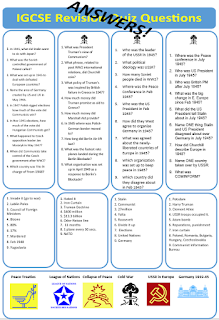
I don't honestly remember who inspired this format - but whoever you are on the EduTwitterverse, thanks! This was an attempt to have some quiz-style questions which covered most of the CIE IGCSE History course. Other GCSE courses do some similar topics, and some do different ones; I am sharing this here if you wish to make your own. I have used these questions as lesson starters or as a short test to consolidate a unit. This is partly inspired by the excellent work of Kate Jones and her work on "Retrieval Practice"; I'll write more about this in a future blog post, but in sum the idea is this: In order to get students to fully understand a topic its details have to be stored in long term memory, and be connected to existing knowledge. This is achieved by "calling to mind" the information previously taught and using this information in some way; new information is thus moved from the smaller working memory and stored in the long-term memory. Low-stakes qu...

Bayeux Tapestry Posters and Historical Second Order Concepts

Image
Inspired a little by AQA's GCSE spec where it talks about Second Order Concepts of " continuity, change, cause, consequence, significance, similarity and difference" , and the Bayeux Tapestry Meme-Generator , I came up with these.  They are designed at least to get students thinking about how to use these concepts (having used other similar but less interesting things in the past). Hopefully they will also give students a starting point for their own work. There are probably things one could quibble about; whether the text is readable by SEN, and to what extent these are emphasising the traditional "top-down" understanding of hierarchy by saying that the king is more important than the people. I'll put the files in this Google Drive directory.  Here you'll find the images (which I'll try to print on A3) and the file I downloaded from the  Bayeux Tapestry Meme-Generator , which might allow you to make your own version (I've not had the chan...
Image
Timeline of Inter-War Years and Dictatorships Inspired, as ever by the work of  @worcesterjonny,  and using one of his files as a template, I knocked this Timeline together to cover the Interwar years and the dictators of the 1920s and 1930s. I think it should be useful for display purposes if you can find a printer which can use A2 pages and also for analysis (give an A3 version to your students!). I hope to use it with my IB History students (Paper 3, Europe Topics 14 & 15), and it should be useful for a variety of GCSE courses too. The PDF can be found here The Editable Publisher file can be found here (if you want to do your own version)

Reading around the subject - Poster

Image
I've tried various ways of encouraging students to read around the subject, sometimes with success - mostly talking to keen students about relevant texts is the best way, although a good display helps! With this in mind, I have put this poster together - inspired by the work of Twitter Educationalist Mark Anderson ( https://twitter.com/ICTEvangelist) . It is designed to look like a "periodic table" and is organised into broad themes which we cover in our various courses: As with a real periodic table I have tried to demonstrate a range of complexity; by putting the more straight-forward texts towards the top and the more complex and challenging towards the bottom. In case anyone wants to have their own version for editing (as not everyone covers the Tudors, the Dutch Revolt and Health & the People!) here is the editable PUB file (for MS Publisher 2013) . Here is the PDF file if you'd like that instead !

A Level Timeline - Tudor History 1509-88

Image
In my head I've got a post to write about using Hexagons in teaching, but in the meanwhile I'll post this here while I see if there is a better place to share it. The image below is timeline of selected events in the Tudor period 1509-88 which students can colour-code using the relevant themes, and make connections between events. It's designed around the Edexcel A Level specification for Paper 1, option B, although could probably be used for any Tudor unit. It works well on A2 or A3, but is a little harder to read on A4, as demonstrated below: It was inspired by some of the excellent work by Jonny Hemphill ( @WorcesterJohnny ), so props to him for his magnificent GCSE timelines I have shamelessly used in class! The file itself is a non-editable PDF (sorry if there any errors and typos!), but was make using the free Scribus publishing software. If anyone wants the original file, I am happy to share that too.

First Post!

This is a blog about History teaching and education in general. I'm not sure what will go here but I expect it will be mostly experimental.