Posts

Showing posts with the label Retrieval Practice

Revision, Retrieval and Games
Image
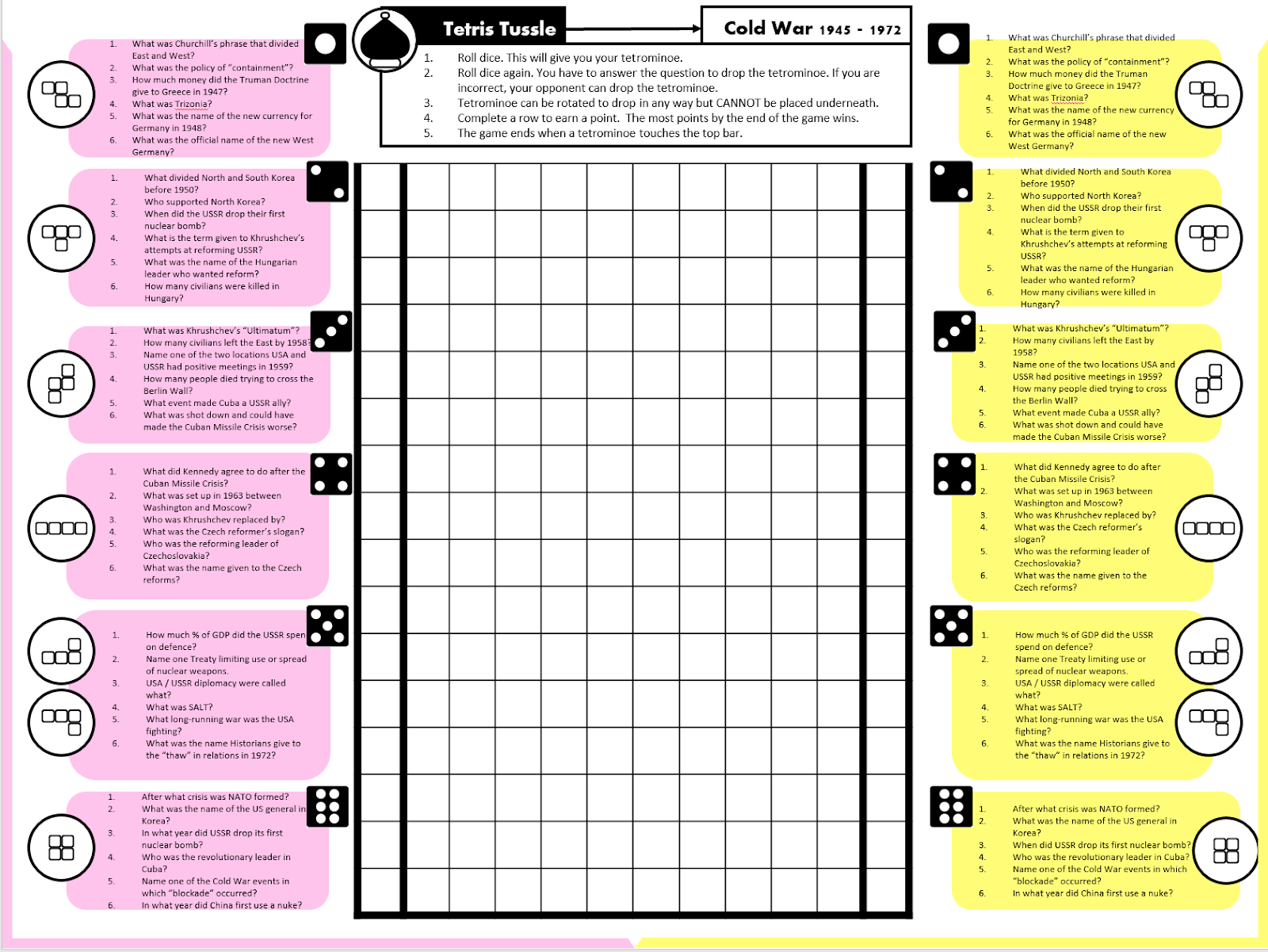
There is a longer post to be written about some of my recent experiments with exploring LGBTQ and race in History more fully in the curriculum. In the mean time I have been doing lots of revision with Year 10 in preparation for their end of Year exam. A little while ago I came across a great Tetris-derived revision game designed by @SPBeale . I used it to create a Cold War-themed version. You should find that each "Tetrominoe" includes questions from a different section of the course, except for two of them which cover the 1960s, and the final one which is a random selection of questions I couldn't fit in anywhere else. All questions can be changed depending on what you teach and which evidence you focus on. Instructions are all on the sheet - about half of my classes had never actually played Tetris before, so had to be guided at first. This may or may not be the case with yours.  All I can say is that the classes really seemed to enjoy the revision game; there was a def...
Knowledge revision quizzes

Image
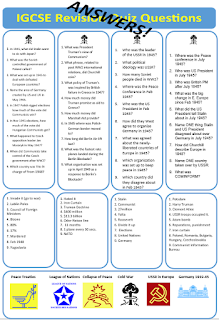
I don't honestly remember who inspired this format - but whoever you are on the EduTwitterverse, thanks! This was an attempt to have some quiz-style questions which covered most of the CIE IGCSE History course. Other GCSE courses do some similar topics, and some do different ones; I am sharing this here if you wish to make your own. I have used these questions as lesson starters or as a short test to consolidate a unit. This is partly inspired by the excellent work of Kate Jones and her work on "Retrieval Practice"; I'll write more about this in a future blog post, but in sum the idea is this: In order to get students to fully understand a topic its details have to be stored in long term memory, and be connected to existing knowledge. This is achieved by "calling to mind" the information previously taught and using this information in some way; new information is thus moved from the smaller working memory and stored in the long-term memory. Low-stakes qu...